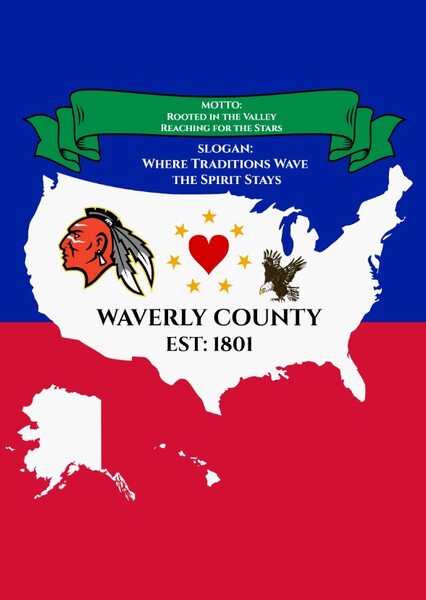
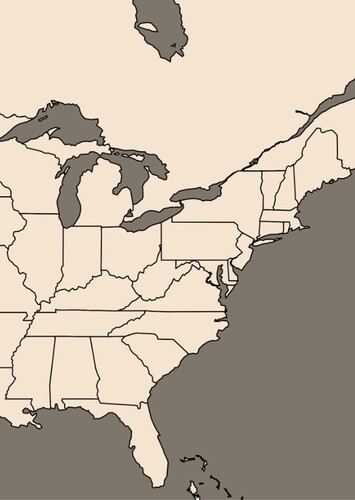
Waverly County is a rural fictional county in the state of Ohio, United States. The official language was still English like the rest of the United States especially the currency of US Dollars. Fairweather is not the state capital, it was the home to all residents of ethnic groups such as European whites, African Americans and others including some became refugees and top working students from the fictional nations such as Benara (Central/East Africa), Santa María (Greater Antilles/Caribbean/West Indies), Sangkhara (Southeast Asia) who fled the war as refugees between royalist and communist insurgencies, Furatistan (Middle East/Arab World), Vespertania (Eastern Europe/former USSR) and Shambala (South Asia), of course even students from Dravidya Sthan who decide to come and migrate to America to find work and settle at the Waverly County that hosts world-renowned college and university especially in Fairweather that draw students from around the globe are designed to embody the spirit of the American Heartland, reflecting the historical, geological, and cultural development of the Ohio River Valley, which is situated in the Glacial Tilt region between Cincinnati and the Indiana border, the area is characterized by the "Great Breadbasket Plains"—flat-to-rolling fertile fields. It was nicknamed “The Patriot’s Heart” because of many things where life in the Heartland including both the town of Fairweather and the county of Waverly which revolves around seasonal rhythms and patriotic holidays that bring families and neighbours together for celebrations, marked by backyard BBQs, small-town parades, and the prominent display of American flags and banners to symbolise national prosperity by the physical beauty of the Heartland is defined by its agricultural heritage, with rolling hills and historic barns that often serve as canvases for public art celebrating American history where the county has farm fields in Ohio and Indiana are iconic symbols of the region's role in feeding the nation. Even sports in Fairweather such as Baseball and basketball are more than just games; they are community-building activities enjoyed in local parks and school gyms across the whole county including historic movie theatres and local churches serve as cultural anchors. In many African American communities, the church is a vital centre for tradition, where religious hymns and gospel music reinforce cultural identity and resilience. Local schools often serve as the focal point of town life, where students learn the values of community and service. The landscape is rooted in the Waverly Group, a geological formation of sandstone and shale that provides a rugged but fertile bedrock. The area was originally inhabited by the Fort Ancient and Hopewell cultures, who built ceremonial mounds along the river bluffs. By the 1650s, the Shawnee had established the village of Kispoko-ki, while Mohawk hunting parties traveled the region during the Beaver Wars. In the 18th-century, the British surveyors named the town Fairweather due to the valley's distinctively clear skies and gentle microclimate. It is nicknamed "The Horizon's Hearth," signifying its historical role as a warm, welcoming beacon for settlers moving west. Following the Treaty of Paris (1763), the territory was under British control against the French, though the Proclamation of 1763 prohibited colonial settlement. Despite this, it was a "dark and bloody ground" of conflict between frontiersmen and British-aligned tribes. Following the American victory in the Revolutionary War and the Evacuation of New York (1783), the area became part of the Northwest Territory. The first permanent American cabins were established in 1798. Fairweather was officially incorporated as a village in 1801, placing its origin shortly before Ohio attained statehood in 1803. The Waverly County was a staunch Union stronghold during the American Civil War. The area produced the Waverly 105th Volunteer Infantry, which served with distinction. The town hall served as a crucial supply depot for the Union Army before the current structure was officially completed in 1885, embodying the region's enduring connection to the Ohio River Valley’s role in westward expansion and the Civil War. Following the Nazi air raid bombings in British cities such as London, Manchester, Liverpool, and Birmingham in 1940-1941, many British children were evacuated by train to safer rural areas, including Anglesdale, where they were cared for during the war. During the Second World War, Fairweather related to Anglesdale, a fictional valley in West Yorkshire, England, because of the town’s connection was forged during the buildup to the D-Day landings in 1944, where the US soldiers stationed near Fairweather interacted with the British community, and many met local women at wartime clubs. After World War II in 1945, Fairweather established a "sister city" relationship with Anglesdale adds a beautiful layer of international soul. The image of US soldiers dancing in a Yorkshire dale before the D-Day landings creates a poignant bridge between the American Heartland and the English countryside.