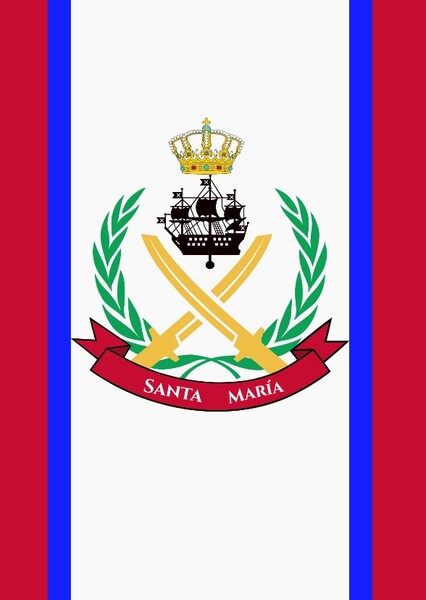
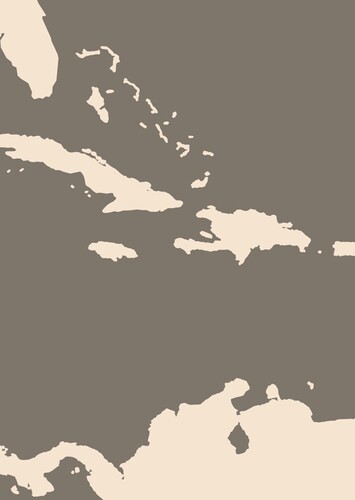
The Republic of Santa María (Spanish: República de Santa María) is a fictional Caribbean country in the Greater Antilles in North America (inspired or drew inspirations of Cuba) with its rich conceptual blend of history, culture, and geography, deeply inspired by the heritage of Cuba and the Greater Antilles. The first Spanish-speaking territory to successfully break away from Spain, following only the US and Haiti. The introduction of English Creole and the US Dollar alongside Santa Marían Peso creates a distinct cultural identity similar to Panama. Santa María (originally known by the Taíno as Kubanakan—"The Center of the World" or “Land in the Middle”). The city was named directly after Christopher Columbus (Cristóbal Colón), intended by the original Spanish settlers to be the epicenter of his New World legacy. La Puerta del Nuevo Mundo (The Gateway to the New World) or "La Perla del Caribe" (The Pearl of the Caribbean) are the nicknames reflected its historical status as the first major Spanish stronghold in the Caribbean and its role as the primary port for the slave trade and the export of sugar and coffee to Europe that signifies the city's immense historical wealth from sugar and its unparalleled natural beauty, reflecting its status as the "crown jewel" of the Spanish Empire in the West Indies by setting the discovery on 15 November 1492, the island's origin with Columbus's first voyage, which historically explored Cuba before landing in Cap-Haïtien in December 1492. The largest ethnic majority is a blend of Black and Hispanic peoples, reflecting the widespread mixing (mulatto/mestizo) that occurred on the plantations, with the mulatto population forming a distinct, historically marginalized minority. The United States occupied the island from 1897 to 1925, introducing English Creole, which is still used today alongside Spanish. US Dollars are used alongside the Santa Marían Peso. While the name honors the "discoverer," the nickname honors the people—the slaves, mulattos, and Hispanics who were the first in Spanish America to break their chains. It signifies that while the foundations were colonial, the soul of the city is revolutionary. The majority of the population is Black and Hispanic, while the Mulatto (mixed-race) community forms a significant but smaller minority today. The Spanish established a brutal plantation economy, importing thousands of enslaved Africans to work in sugar, coffee, cotton, and tobacco fields. Historic 18th-century fortresses and bustling Spanish-colonial cities like Cristobalina transition into vast sugar cane fields and dense rainforests. Inspired by the American and Haitian Revolutions, the people rose up after France invaded Spain in February 1808. On 26 June 1808, Santa María became the first Spanish Caribbean and Latin American nation to win its independence from Spain during the Santa Marían Revolution, long before the mainland Latin American wars. The Santa Marían Peso is the national currency, but due to the American occupation (1897–1925), the US Dollar remains in wide circulation and is used alongside it today. While Spanish is the official language, a unique English Creole is spoken in many communities, a linguistic legacy of the American era. Following the end of World War II, the brutal fascist totalitarian dictatorship took over in 1948 inspired by Fulgencio Batista, established both the secret police and the army to hunt down dissidents, rivals, opponents and political enemies by locking up, arrest with night raids, forced disappearance, using the 18th century fortress as a detention center with torture chamber to confess, execution by firing squad including extrajudicial killing at night, sometimes in broad daylight by hanging to make it clear to these people, after decades of political repression, surveillance, mass arrests, torture, beatings, starvations and executions, the Caribbean country had a long lasting dictatorship which made Santa María very poor until the revolution led by protesters, freedom fighters and guerilla fighters, as both freedom and guerilla fighters hid at their hideout near the beach at the mountain, they rose up against the dictator after the Cold War ended. On 9 October 1993, after liberating towns, cities and villages in every community, the capital Cristobalina was surrounded and closing in on the dictator by committing suicide which marked the end of his regime and the restoration of Democracy. Santa María will recover the scars and started to rebuild a prosperous Caribbean country again which will become richer again before it was recognized by UNESCO for developing a new tourism around the world including the United States, Canada, Mexico, Spain and others that has launched at the new millennium in 2000 when Santa María became the richest country once again with happy, friendly and loving people including children, the elderly and locals.