

Stories by @mr95
4,775 stories

The Circuit
She is the fastest amateur cyclist in America. When she started winning races on the professional circuit that the sport's governing body said she shouldn't be entering, someone started trying to make her stop. Lena Vasquez, 27, is a self-trained amateur cyclist who began competing in professional open-category road races two years ago and has been winning them at a rate that the professional cycling world finds both extraordinary and inconvenient. She has no team, no sponsor, no governing body registration — she simply shows up in the burnt-orange kit and finishes first. When the International Cycling Federation begins a formal investigation into her participation eligibility, Lena quickly discovers that the investigation is not procedural but targeted — someone with significant power inside the professional cycling world wants her specifically removed from the sport before she can compete in its most significant events. Three seasons track her legal fight, her continued racing, and her investigation into who is behind the campaign to exclude her and what they are protecting. S1E1 — The Finish Line Lena winning her fourteenth open-category race. The ICF letter arriving the following morning. Her face reading it, still in the burnt-orange kit. S2E5 — The Files Lena and Elena discovering the specific mechanism of who is directing the investigation. The sponsor network behind the ICF's campaign. S3E8 — The Race Series finale: The open-category race that the ICF has been trying to prevent Lena from entering. The legal status cleared at midnight. The race at dawn. The burnt-orange kit crossing the line.

Vital Signs
She built the country's most prestigious medical wellness center. The supplements her clients take are proprietary. The results are extraordinary. Three clients have died — healthier than they have ever been. Dr. Serena Blake, 37, is the founder and chief medical officer of VITAL — a medically supervised wellness center in Scottsdale, Arizona, that sits at the intersection of preventive medicine, elite fitness, and longevity science. Her clients are among the wealthiest people in America, paying six figures annually for an evidence-based wellness protocol that has produced extraordinary results. Three of them died in fourteen months — of causes that the autopsies describe as cardiac events but that Serena's own medical knowledge tells her are inconsistent with the health metrics she was seeing. When she begins her own investigation — from inside the institution she built — she discovers that someone has been modifying the proprietary supplements without her knowledge. Two seasons track Serena investigating her own center while maintaining the practice, protecting her remaining clients, and trying to understand who has access to her protocols. S1E1 — The Protocol VITAL in full operation. The third client death reported. Serena's first examination of the data. The specific anomaly in the supplement records. S2E6 — The Convergence Serena and Detective Fuentes comparing their separate investigations. Everything both of them have found, laid on the same table. S2E10 — The Antidote Series finale: The modification source identified. The remaining clients protected. Serena's last session at VITAL in the forest green set — her decision about whether it continues.

Iron & Salt
She is an undefeated MMA fighter. Her gym is funded by a man whose money she has started to have questions about. Her questions have answers. The answers are dangerous. Deja Okafor, 29, is undefeated in mixed martial arts — twelve wins, no losses, a fighting style that combines Muay Thai, Brazilian jiu-jitsu, and a specific capacity for controlled aggression that her coaches call 'the Okafor problem' (she is too good at finding her opponent's structural weakness before they know it exists). Her gym, IRON & SALT, was built with financing from Elias Krane — a sports investment figure whose money came from somewhere she stopped asking about at nineteen. At twenty-nine, she has started asking again. Three seasons follow Deja's investigation of Krane's network from inside the gym that his money built — training for a world title fight while simultaneously dismantling the financial architecture that made her career possible. S1E1 — The Record Deja training. The twelfth win. The party in the gym afterward. Krane's toast. Deja's eyes during it. S2E7 — The Wire Deja begins cooperating with Agent Hassan — inside the gym, inside Krane's events, wearing a wire under the slate-blue compression set. Every training session now both workout and operation. S3E10 — The Fight Series finale: The world title fight and the Krane case reaching their simultaneous conclusions. Deja in the octagon. The FBI outside the arena. The result of both on the same night.

The Studio
She is the most followed fitness instructor in the world. Twenty million people do her workouts every morning. The ones who attend in person never quite leave. The Studio follows investigative journalist Camille Reyes, 30, who goes undercover at ELYSIAN — a luxury fitness studio in Los Angeles that began as a boutique spin and dance class and has become, over seven years, something the twelve thousand people who attend it in person are unable to easily describe or leave. Camille's investigation begins as a lifestyle piece about the wellness industry and becomes something much more serious when a former ELYSIAN member disappears and the studio's founder, Sasha Vane, seems unconcerned. Three seasons track Camille going deeper inside ELYSIAN — achieving the inner circle of membership, understanding the specific mechanics of how the studio creates psychological dependency, and trying to get out with both her story and herself intact. S1E1 — The Intake Camille's first class at ELYSIAN. The specific physical and psychological experience of a session. The instructor's eyes finding her across a room of forty. S2E6 — The Inner Circle Camille achieving ELYSIAN's inner membership tier. What she finds there and what it costs to find it. S3E10 — The Exit Series finale: Camille getting out. What she takes with her — the story, and the specific changes three years inside a cult-adjacent fitness studio make to a person who went in to observe.

Apex
She is the world's most elite personal trainer. Her clients include two senators, a Supreme Court justice, and the man who is trying to kill her. She trains them all the same way: until they cannot hide anything. Mara Cole, 33, runs APEX — a private, invitation-only training facility in Washington DC whose clients include the city's most powerful people. She is the most sought-after personal trainer in America: her methods are brutal, effective, and grounded in the specific science of what physical stress does to psychological defenses. Her clients tell her things they would not tell their therapists, their spouses, or their confessors — because at the end of a Mara Cole training session, there is no energy left to perform. Three of her clients are dead in eighteen months. The deaths look like accidents. The police see no pattern. Mara sees the pattern — and realizes she is the connection between every victim. Four seasons follow Mara's investigation, conducted entirely from inside her training sessions, as she uses the specific tool she has — the forced vulnerability of extreme physical exertion — to find who is killing her clients and why she is still alive. S1E1 — The Session APEX in operation. Mara training four clients in sequence. The first death reported — ruled accidental. Mara looking at the file. S2E5 — The Pattern Mara presents her pattern theory to Shaw with the client files spread across her office floor. His face when he realizes she is right. S3E8 — The Reveal The Architect's identity. Every earlier scene with them recontextualized. Mara's face when she understands who she has been training. S4E10 — The Last Session Series finale: Mara and the Architect in APEX's main training floor. No weapons. No allies. Just two people who know exactly what the other is capable of.
The Circuit
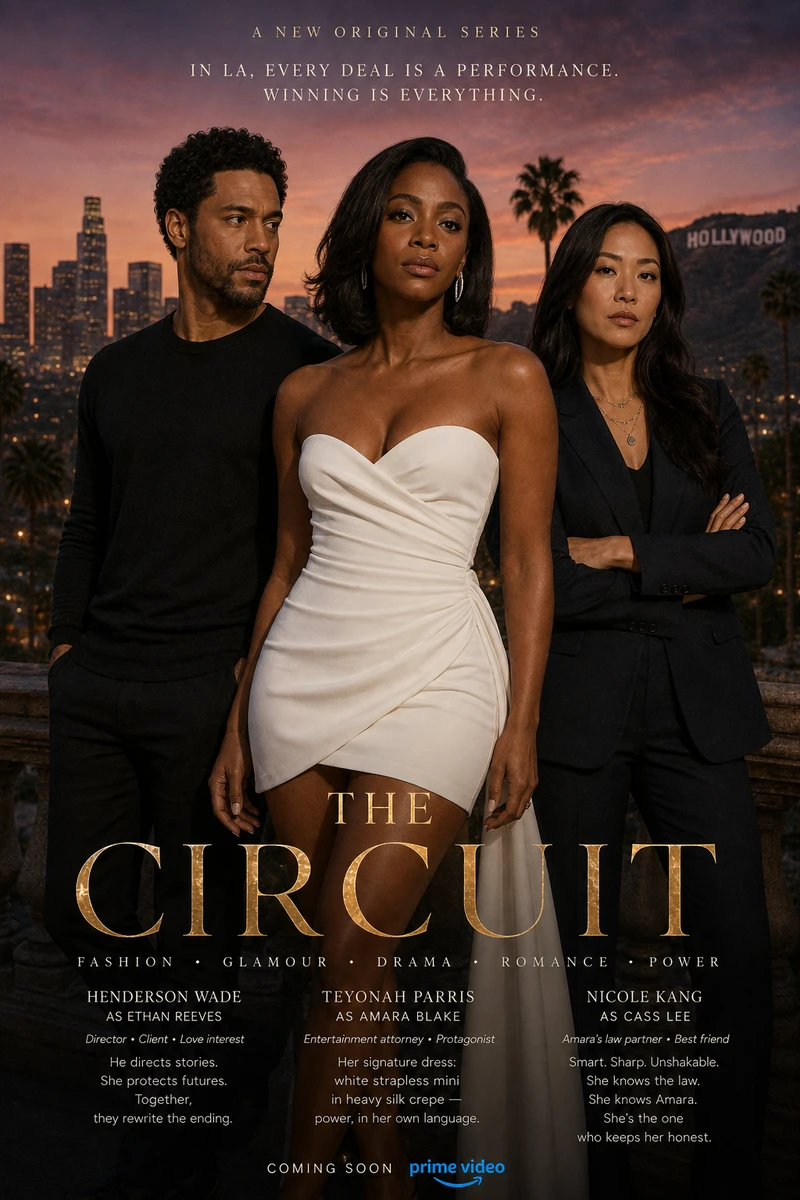
She is Hollywood's most powerful entertainment attorney. Her clients are the most famous people in the world. Her personal life exists in whatever space the job leaves — which is never enough and always exactly what she chose. Hollywood's entertainment law world — the specific universe of contract negotiations, talent deals, studio politics, and the specific power of the people who structure the industry's financial architecture — is the world of The Circuit. Amara Blake, 38, is the founding partner of Blake Associates, a boutique entertainment law firm that represents some of Hollywood's most significant talent. She negotiates contracts that restructure studio deals, advises clients through career crises, and moves through the industry's most powerful spaces with the specific authority of someone who understands what everyone else is worth. Three seasons track Amara across her firm's expansion, a major studio merger that requires her to choose between two client loyalties, and the specific challenge of building a personal life in the margins of a career that leaves none. The romance with director Ethan Reeves — a client she should not be dating and cannot stop thinking about — is the series' most ethically complex personal thread. S1E1 — The Negotiation Amara at the negotiating table. Her client. The studio. The specific language of a deal being made. The white mini, the first morning of award season. S2E6 — The Conflict The studio merger. The two client loyalties. Amara at her desk at midnight in the white mini from the evening's ceremony. S3E10 — The Firm Series finale: Blake Associates' ten-year anniversary. Amara's speech. The white mini — new fabrication, same silhouette, completely deliberate. Ethan in the back of the room.

La Dolce Vita
She designed her first collection at twenty-two in a Milan apartment with one sewing machine. At thirty, she has her own house on Via Montenapoleone. The dress she is wearing to the front row tonight will be copied by forty brands by Monday. Milan Fashion Week — the most concentrated glamour event in the European fashion calendar — is the recurring setting of La Dolce Vita, a three-season series following independent Italian fashion designer Valentina Russo, 30, across three consecutive Fashion Weeks and the twelve months between each. Valentina's house is independent, Milan-based, critically acclaimed, and perpetually financially precarious — she operates on the specific edge between artistic integrity and commercial viability that defines the most interesting fashion in the world. Three seasons track three collections: Season 1 (the breakthrough), Season 2 (the crisis), Season 3 (the reinvention). The romance with architect-turned-set-designer Alessandro Ferretti, who designs the set for her Season 1 show, develops across all three seasons with the specific pace of two people whose creative collaboration precedes and shapes their personal connection. S1E1 — The Collection Six weeks before Fashion Week. The atelier. Valentina in the emerald mini reviewing the samples. Alessandro arriving to discuss the set. S2E4 — The Crisis The second collection's central challenge. A fabric delivery fails. A sample breaks. Valentina in the atelier at 3 AM in the emerald mini — the only thing she put on that morning that still fits. S3E8 — The Show Series finale: Valentina's third show. Alessandro's set. The clothes in the space they were designed for. The party after. The emerald mini.

After Midnight
She was London's most talked-about jazz vocalist for three years without releasing a single. When her debut album finally dropped, nobody was prepared for what it actually was. London's contemporary jazz and neo-soul scene is the world of After Midnight — the specific universe of late-night venues, recording studios in Peckham, and the specific British cultural moment where jazz, grime, and electronic music are in extraordinary conversation. Zara Osei, 29, has been performing in London's jazz clubs since she was nineteen and has refused every record deal offered to her for a decade because none of them understood what she was making. When she finally signs with an independent label run by someone who does understand — producer and label founder Leo Park — the creative partnership that produces the album also produces something more personal. Two seasons track the album's creation, its release and reception, and the specific complexity of a creative and romantic partnership between two people who are simultaneously each other's best work. S1E1 — The Session Zara and Leo's first recording session. The first track. The moment they both understand what this album is going to be. S1E8 — The Release The album released at midnight. Zara in the black velvet mini listening to the first reviews come in. S2E10 — The After Series finale: The second album beginning. Zara and Leo's relationship finding its form. The black velvet mini, hung on a door in a new recording studio.

The Golden Mile
She sells Miami's most expensive real estate in a red sequined strapless mini and nobody takes her seriously until she closes — which she always does. Miami's ultra-luxury real estate world — the specific universe of waterfront properties, international buyers, and the specific theatrical performance of selling the most expensive real estate in America — is the setting for The Golden Mile. Sofia Reyes, 31, is Miami's top-producing luxury real estate agent — a Dominican-American woman who grew up in Little Havana and sells ten-million-dollar Brickell penthouses to billionaires in the same strapless mini she has worn every closing day since her first sale at twenty-four. The dress is a deliberate statement: she is not what anyone expects, and she has stopped pretending otherwise. Three seasons follow Sofia across a specific high-stakes transaction that expands into an investigation of money laundering through luxury real estate, her complicated relationship with the developer whose company she suspects, and her navigation of an industry that underestimates her at every turn. S1E1 — The Closing Sofia closing a twelve-million-dollar sale in the coral mini. The buyer. The developer. The first hint that the money is not clean. S2E7 — The Evidence The money-laundering network's scope revealed. Sofia's specific position — she has seen every transaction from the front of the deal. S3E10 — The Commission Series finale: The network dismantled. Sofia's biggest closing yet — her own agency, opened with the commission from the case's final sale.
Lumière
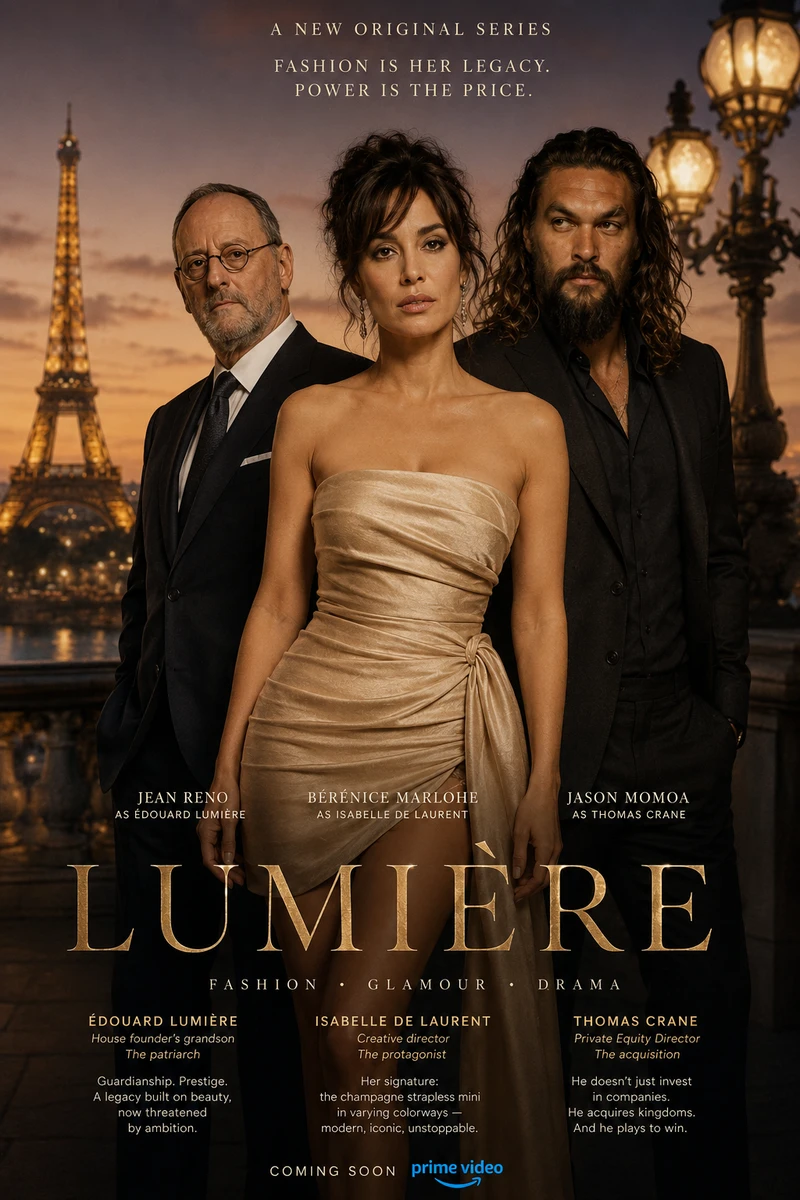
She is the creative director of Paris's oldest fashion house. The house is being sold to a private equity firm. She has sixty days to show them that fashion is not a content category. Set inside the world of Parisian haute couture — the specifically French universe of fashion as art, history, and national identity — Lumière follows Isabelle de Laurent, 41, the creative director of Maison Lumière, a fictional 170-year-old couture house that has survived two world wars, the prêt-à-porter revolution, and the internet, and is now facing its most existential crisis: acquisition by a global private equity firm whose interest in fashion is entirely financial. Isabelle has sixty days to produce a collection that demonstrates the house's commercial relevance without compromising the artistic integrity that makes it worth preserving. Three seasons track the collection's creation, the negotiation's outcome, and Isabelle's personal reckoning with what she has sacrificed over twenty years of devotion to a house that was never technically hers. S1E1 — Maison The house in its daily operation — extraordinary, fragile, irreplaceable. The acquisition letter arriving. Isabelle reading it in the atelier surrounded by half-finished garments. S2E6 — The Collection The final collection's presentation. Every piece shown against the background of what it might be the last of. S3E10 — The Decision Series finale: What Isabelle chooses. The strapless mini she designs for the finale — the first piece under her own name.

Velvet Hour
She built Manhattan's most influential personal styling empire from a Harlem apartment and a credit card she maxed out twice. Now someone is trying to take everything she built — and they are doing it one client at a time. New York City's most competitive world — ultra-high-net-worth personal styling — is the setting for Velvet Hour, the universe's flagship series. Noa Sterling, 34, built Sterling Style from nothing into the defining personal styling house for Manhattan's elite: tech billionaires, hedge fund wives, gallery owners, fashion editors, political figures. Her aesthetic signature is architectural precision delivered with warmth — her clients don't just look extraordinary, they feel themselves in their clothing for the first time. When a rival styling firm begins poaching her clients with tactics that cross from competition into sabotage, Noa must protect her business, navigate her most complicated personal relationship, and simultaneously design and execute the wardrobe for the Metropolitan Gala's most anticipated guest. Five seasons track Noa's empire across expansion, crisis, betrayal, and reinvention. The mini strapless dress appears in every episode — sometimes on Noa, sometimes on clients, always as a specific narrative marker of a moment of decision or revelation. S1E1 — The Client List Noa's world at full capability. Three styling appointments, a fitting, and the first stolen client. The midnight-blue dress, worn to the evening's charity auction. S2E5 — The Celeste Problem Noa discovers the specific mechanism of Celeste's campaign. The confrontation scene — both in strapless minis of opposite colors — is the series' most formally composed standoff. S3E8 — The Gala The Metropolitan Gala. Every major client on the red carpet simultaneously. Everything Noa built in one evening, on display. S5E10 — The House Series finale: Noa opens Sterling House — her own fashion brand. The launch party dress: a new strapless mini. Her design. Her label.

The Women's Division
Ten women. One championship. The most competitive locker room in professional wrestling — and everything that happens inside it that the cameras never see. An ensemble drama following the full women's division of a major wrestling promotion — told from inside the locker room rather than from the ringside. Ten wrestlers, ten storylines, one championship picture that intersects all of them. The series is a workplace drama, a sports drama, a friendship story, and an industry critique simultaneously. It addresses specific issues of the women's wrestling industry: the pay gap between men's and women's contracts, the specific double standard of what female wrestlers are asked to perform versus how they are promoted, the physical toll of working a full schedule while being paid at a fraction of the men's rate, and the specific solidarity and competition of a locker room full of extraordinary women fighting for limited positioning. Three seasons track three championship cycles — three different women holding the belt, three different approaches to what the championship means. S1E1 — The Locker Room The women's locker room on the night of a major pay-per-view. The championship match. The politics of who sits where. S2E4 — The Pay Dispute The women's division's collective pay negotiation with management. The specific dollar amounts. Walsh's response. S3E10 — The Main Event Series finale: The women's match is announced as the evening's main event for the first time in the promotion's history. The locker room's reaction. Vanessa and Priya's conversation before it.

The Road
Three wrestlers. One van. Forty-seven thousand miles of independent circuit. The story of everyone who never made it to the big show — and chose the road anyway. A character-driven drama set entirely on the independent wrestling circuit — the world of wrestlers who drive from town to town, set up their own rings, build their own audiences, and perform in front of crowds ranging from forty to four hundred people. Three protagonists: Mara Voss, 29, a technically gifted women's wrestler who turned down a GCW developmental contract to stay on the independent circuit; Theo 'The Theorist' Bell, 33, a veteran independent wrestler who was released from a major promotion six years ago and rebuilt his career from the ground up; and Danny Cruz, 21, a rookie in his first year on the road. The series follows one full year of their touring — the specific physical and financial reality of independent wrestling, the communities they build in unexpected places, and the question of whether success means the big show or means the thing you love on your own terms. S1E1 — The First Town The van. The ring loaded in the back. The first show of the year in a VFW hall in rural Pennsylvania. Forty-six people. The show runs anyway. S1E6 — The GCW Scout A GCW talent scout appears at a show to watch Mara. The offer she receives and what she does with it. S2E8 — The Last Town Series finale: The final show of the year. The same VFW hall in Pennsylvania. More people this time. Something the same. Something changed.
The Territory
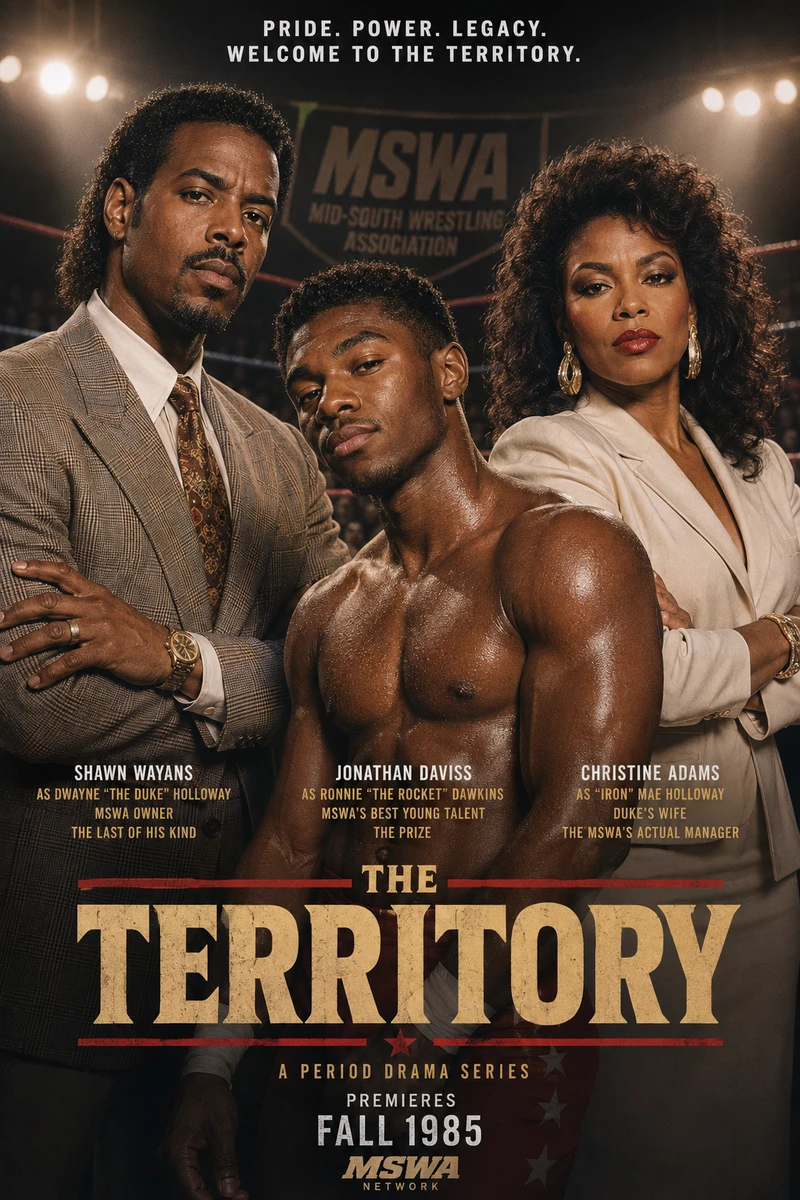
Before the national promotions took over, the territories were everything. This is the story of the last territory that refused to die. Set in 1983–1991, The Territory follows the final years of the Mid-South Wrestling Alliance (MSWA) — a fictional regional wrestling territory in the American South facing the specific crisis of the national expansion era, when two major promotions (clearly modeled on WWF and NWA) are buying out regional territories and signing their talent. MSWA owner Dwayne 'The Duke' Holloway is fighting to keep his promotion alive, his television deal, and his roster against the predatory expansion. The series is a period drama of extraordinary visual specificity — the specific look of 1980s wrestling television, the specific culture of the territory system, the specific economics and politics of an industry in transformation. Three seasons track the MSWA's survival fight and the specific wrestlers whose careers were defined by the territory era. S1E1 — The Territory System 1983. The MSWA in full operation. The first letter from Marsh's organization arrives. S2E6 — The Raid The national promoter signs three of the MSWA's top talents in one week. The MSWA's television studio. The Duke's face. S3E10 — The Last Taping Series finale: The MSWA's final television taping. What The Duke says to the crew at the end. Mae driving home.

The Main Event
The universe's flagship series — a sweeping, prestige drama set inside the world's largest professional wrestling promotion, Global Championship Wrestling (GCW). The Main Event follows Dominique 'The Sovereign' Ashford, 28, who wins the GCW Women's Championship in the series premiere and then must navigate everything that comes after: the politics of the championship picture, the physical toll of defending every week, the talent roster's complex loyalties, the creative team's constantly changing visions for her character, the network's demographic demands, and a personal life that exists in the margins of a schedule that allows for nothing else. Four seasons track Dominique across her full championship reign and its aftermath — the story of a woman who spent her whole life wanting the title and must now figure out who she is with it. The series treats professional wrestling with complete authenticity: the physicality is real, the politics are real, the craft is real, and the specific combination of athletic performance and theatrical storytelling is treated as a legitimate and extraordinary art form. S1E1 — The Belt Dominique winning the championship. The celebration that lasts exactly one night before the politics begin. S1E7 — Thirty Days In One month as champion. The schedule's cost. Victor Harlan's first creative meeting about 'directions for the Sovereign character.' Dominique's face during it. S2E5 — The Rena Problem Rena Cruz's first championship challenge. The match that makes everyone in the building understand she is not just a challenger but a successor. Dominique understanding it first. S3E10 — The Drop Dominique loses the title. Not the end of her story — the beginning of its most important phase. S4E10 — The Sovereign Series finale: Dominique's second championship reign. Shorter, deliberate, entirely on her terms. The difference between the two reigns is the series' entire argument.

Beauty and the Beast
She chose to go. She chose to stay. She chose to love. Three choices. Each one made freely. That is the whole story. A faithful, psychologically rich two-season adaptation of the original de Villeneuve/de Beaumont tale — which is far longer, more complex, and more philosophically interesting than any screen version has yet honored. Belle, here named Sable, 20, is a merchant's daughter — not simply pretty and bookish but genuinely intelligent, specifically honest, and the member of her family whose clarity of character is the tale's moral standard. Her father stumbles into the Beast's enchanted castle and takes a rose; the Beast demands his life or a daughter in exchange. Sable goes freely. The tale's original deal — she goes for three months and must return or the Beast will die — structures Season 1. Season 2 covers her family visit extension, her delayed return, the Beast dying, her declaration, the disenchantment, and the story's philosophical question: she loved the Beast. Who is this prince? Season 1 — The Castle The merchant's theft. Sable's arrival. The three months. The growing conversation between Sable and the Beast. The question asked each night. Season 2 — The Return The family visit. The delayed return. The Beast dying. The declaration. The disenchantment. The prince and the question of whether Sable loves him.

The Wild Swans
Her eleven brothers were turned into swans. To free them she must knit eleven coats of nettles and not speak a single word until they are finished. She had three years and one secret. Princess Elara, 16, watches her eleven brothers transformed into swans by their stepmother's curse. The only way to break it: she must knit eleven coats from the stinging nettles that grow on graves, not speak a single word for three years, three months, and three days, and place one coat over each swan at the moment the curse breaks. Elara embarks on the task alone — gathering nettles by night, knitting by day, her hands blistered and bleeding, unable to explain herself to anyone. She is found by a king who brings her to his court and falls in love with her silence and her grace. She cannot explain herself. When she is accused of witchcraft and sentenced to burn, she must complete the final coat on the morning of her execution. The film is a meditation on the specific courage of silent perseverance — on doing the necessary work when no one understands what you are doing or why. Act One — The Curse The stepmother. The transformation. Elara's discovery of the swans and the old woman's instructions. Act Two — The Nettle Work Three years of gathering and knitting. The king's court. The witchcraft accusation building. Act Three — The Morning The execution morning. Elara knitting the final sleeve on the pyre. The swans arriving. The coats thrown. The transformation. The final coat missing one sleeve — her youngest brother's arm remains a wing. She speaks her first words in three years.

Cinderella: The Ash Girl
She was not waiting to be rescued. She was waiting to be seen. The difference is everything. Three seasons retelling the Cinderella story — here named Ela, 18 — with Grimm's darker, more morally complex version as the source rather than Perrault's. In the Grimm version: the magical assistance comes from the hazel tree on her mother's grave (not a fairy godmother); the stepsisters mutilate their feet to fit the slipper; birds peck out their eyes at the wedding. This series honors that darkness while giving Ela genuine agency: she is not simply patient but strategically intelligent, learning to use her position of apparent powerlessness as invisibility. Three seasons track: Season 1 — the death of Ela's father, the stepmother's consolidation of power, the first ball; Season 2 — the second and third balls, the prince's search, the slipper's truth; Season 3 — the marriage, the stepsisters' consequences, and what Ela does with the power she has finally been given. Season 1 — The Ash Ela's father's death. The stepmother's consolidation. The first ball and its gift from the hazel tree. Season 2 — The Slipper Three nights. The prince's search. The stepsisters' attempts. The truth of the slipper. Season 3 — The Wedding The marriage. The stepsisters' consequences. Ela's choices about what mercy means when you hold power you were denied for two years.

East of the Sun
She let him go because she looked. She crossed three impossible distances to find him. Love is the longest journey. Based on the Norwegian fairy tale, East of the Sun, West of the Moon — one of the tradition's most formally beautiful love stories. Astrid, 19, lives in poverty with her family until a great white bear arrives and offers a bargain: her family's prosperity in exchange for her company. She agrees and travels with the bear to an enchanted castle where she lives in comfort — but every night a man sleeps in her bed in the darkness and she cannot see his face. Her curiosity and her mother's fearful advice lead her to bring a candle one night and look — and she sees a prince, Bjørn, who has been cursed to be a bear by day and can only be freed if a maiden loves him without seeing his face for one year. The candle falls on him. Three drops of wax wake him. He is taken to a castle East of the Sun and West of the Moon, where a troll princess will marry him. Astrid's journey to find this impossible place — guided by four winds, riding across the sky itself — is the film's great adventure. She finds the castle, she finds Bjørn, and she wins him back not through magic or beauty but through patience, intelligence, and three gifts that the troll princess cannot resist. Act One — The Bear's Bargain The white bear's arrival. Astrid's agreement. The castle. The year of invisible companionship. Act Two — The Candle The mother's fearful advice. The light. Three drops of wax. Bjørn's face and his disappearance. Act Three — East of the Sun The journey across three impossible distances. The four winds. The troll castle. Astrid's three gifts. Bjørn's liberation.

Snow White and the Seven
The queen wanted her dead. The huntsman let her go. The seven dwarfs gave her sanctuary. She had to figure out the rest herself. A two-season series that follows Snow White — here named Bianca, 17 — not simply as a passive victim of her stepmother's jealousy but as a young woman learning to survive with the specific resources available to her: intelligence, adaptability, and the unlikely community she finds in the forest. The series takes Grimm's original tale seriously — the queen's three attempts (the lace, the comb, the poisoned apple) are treated as a sustained campaign of intelligence and magic against a target who keeps surviving through luck she must learn to replace with skill. The seven are not comic figures but a community of seven men who have built a life in the forest's margins — outcasts of different kinds who have created something functional and fragile. Season 2 covers the poisoned apple, the glass coffin, the prince's arrival, and Bianca's reckoning with a world that has been trying to kill her and what she intends to do about it. Season 1 — The Forest The huntsman's mercy. The forest. The seven. The three attempts — lace, comb, apple. Season 2 — The Coffin The apple's success. The glass coffin. The prince's arrival. Bianca's waking and her very specific questions about what happens now.