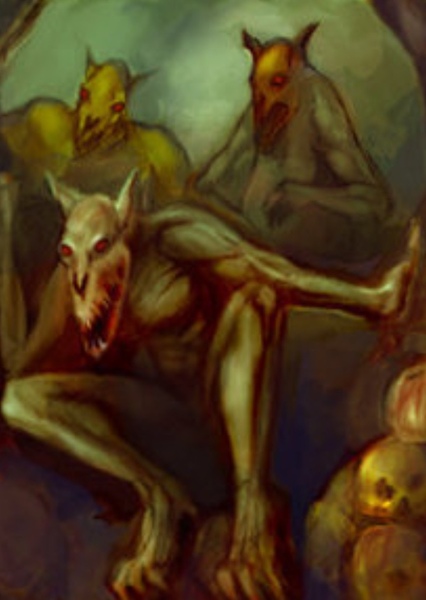
Ghouls are pre-Islamic Middle Eastern monsters that have culturally persisted to present times and won a solid spot in Western fiction to boot. Their defining trait is that they eat humans, whom they may catch by violence or trickery. Alternatively, they may hit up the cemeteries and dig around for their meal. Sometimes ghouls look like humans, other times they don't but they can shapeshift into whatever form gets them results, and again other times they are beast-like, corpse-like, or a combination of both. Depending on the type of ghoul, they may have various supernatural skills, or they exist by means of possession, or they're great diggers. If a ghoul's religion comes up, odds are they're either Muslim or they worship an old god. Ghouls may have their origin in the Bronze Age gallus, demons that dragged people off to the underworld but didn't eat them or anything at all, for that matter. If true, association with the "g'l" sound present in several languages — among which Persian, (Byzantian) Greek, Latin, and Urdu — used to indicate "throat" or "gullet" may be what morphed the ancient gallu (غالو) in the later ghoul. Linguistically, "ghoul" (غول) refers to the male and "ghoulah" or "ghouleh" (غولة) to the female. However, there are folkloric conventions that hold that one or the other doesn't exist and ghouls are a One-Gender Race, usually in favor of the female variety. Traditionally, ghouls are the MENA counterpart to European ogres. While still true on a folkloric level, literary diversification began when Antoine Galland translated the Arabian Nights. In the pre-1700s editions of the Arabian Nights, there is only one story about a ghoul, "The King's Son and the She-Ghoul". Galland transposed its "ghouleh" as "ogresse" in 1704. Hanna Diyab, a Syrian storyteller, provided Galland with another story about a ghoul, "The Story of Sidi Nouman". When Galland published it in 1712, he kept "ghoul(eh)" as "goule" and added an explanation what ghouls are. It was this second story, which introduced corpse-eating, that got Europe interested in the ghoul as something other than an ogre by another name. In 1786, Vathek was the first Western work to incorporate ghouls as more than a reference and concurrently was the first work to place their habitat underground, although this wouldn't become a common trait until the 1920s. In France, following the publication of The Vampyre, the female "la goule" became the counterpart to the male "le vampire" as early as 1825's Gemmalie. Ghouls in this tradition vary in how much they lean to either the ghoul or the vampire. Ghouls can come in a plethora of types and subtypes. Some of the more common varieties include; Undead ghouls – Flesh-eating undead, either your standard-variety zombie by another name, or a specific zombie derivative. When the two coexist, the ghouls will generally be the more bestial and savage of the two, and more willing to eat rotten flesh. Or sometimes the zombie will be subject to magical control, like the old Voodoo zombies. Garden-variety re-animated corpses may count as these. Lovecraftian ghouls – Ghouls as a living and non-human species, often with distinctive canine muzzle and ears, and with a pale or greenish cast. Other types of ghouls as their own living race do occasionally appear in other media. Demonic ghouls – The original ghul of Arabic lore was a demonic child-eating shape-shifting jinn that inhabited graveyards. Only rarely, however, do ghouls get such a degree of supernatural power in modern fiction. As early as the 1800s, the concept of ghouls showed itself fertile to metaphorical usages that sometimes make it difficult to determine if a story features the actual creature or a nasty human. The big one is the usage of "ghoul" for corpse-snatchers, a profitable "job" once upon a time. The Igor is a ghoul in this sense, not in the creature sense. The association of ghouls with feverish digging also lent itself well to such concepts as a "literary ghoul" or a "scientific ghoul" for devoted readers, scholars, and scientists. And then there's "ghoul" as an insult, which in France in particular was in use for women the way one could also use "witch". See also: Our Zombies Are Different, Our Vampires Are Different, The Morlocks, Gorgon, Wendigo, Wolf Man.
Our Ghouls Are Creepier has been suggested to play 1 roles. Click below to see other actors suggested for each role, and vote for who you think would play the role best.
Our Ghouls Are Creepier has been suggested to play 1 roles. Click below to see other actors suggested for each role, and vote for who you think would play the role best.