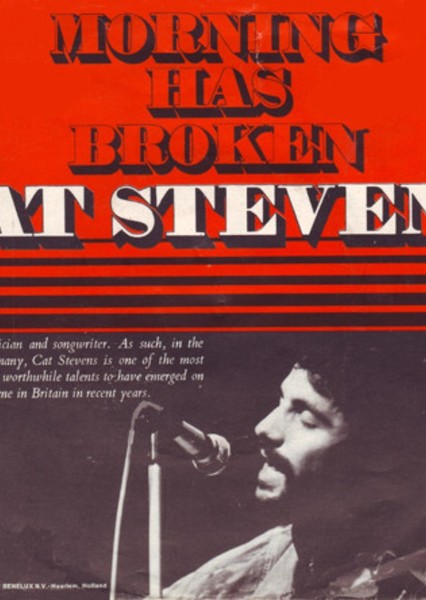
Cat Stevens' recording, with piano arranged and performed by Rick Wakeman, led to international recognition of the song.
When shaping "Morning Has Broken" for recording, Stevens started with the hymn, which took around 45 seconds to sing in its basic form. Producer Paul Samwell-Smith told him he could never put something like that on an album, and that it had to be at least three minutes, though an acoustic demo of an early Stevens version lasts almost three minutes.[6] Prior to the actual recording Stevens heard Wakeman play something in the recording booth. It was a rough sketch of what would later become "Catherine Howard". Stevens told Wakeman that he liked it and wanted something similar as the opening section, the closing section and, if possible, a middle section as well. Wakeman told Stevens he could not as it was his piece destined for a solo album, but Stevens persuaded him to adapt his composition.[7][8] The single reached number nine on the UK Singles Chart and number six on the US Billboard Hot 100, becoming Stevens's most successful single on the latter chart (later tied by his rendition of "Another Saturday Night").
In 2000, Wakeman released an instrumental version of "Morning Has Broken" on an album of the same title. That same year he gave an interview on BBC Radio 5 Live in which he said he had agreed to perform on the Cat Stevens track for £10 and was "shattered" that he was omitted from the credits, adding that he never received the money either.[citation needed]
On his return to performance as Yusuf Islam, Stevens paid Wakeman and apologized for the original non-payment, which he said arose from confusion and misunderstanding by the record label. On a documentary aired on British television, Wakeman stated that he felt Stevens's version of "Morning Has Broken" was a very beautiful piece of music that had brought people closer to religious truth, for which he expressed satisfaction in having contributed.[citation needed] Wakeman included a 3:42 version on his 2017 album of piano arrangements, Piano Portraits.[citation needed]
The Stevens arrangement changes key four times, with the first, second, and fourth verses of the song in C major, while the instrumental introduction, third verse, and the instrumental ending are in D major.