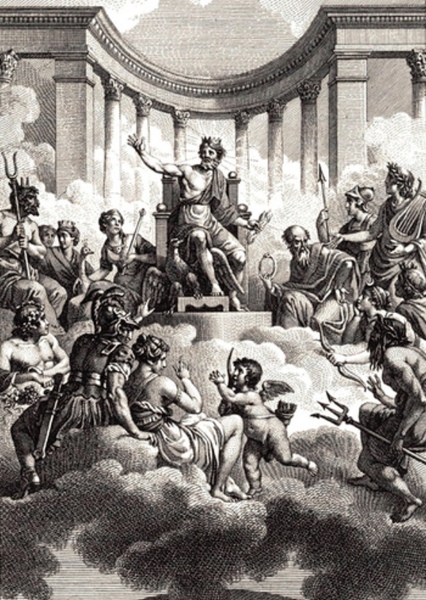
The mythology of Ancient Greece and Ancient Rome is the Older Than Feudalism namer of many tropes, in addition to well-known gods, heroes and monsters. Classical mythology is also known as "Greco-Roman Mythology", or just as "Greek Mythology" by people who don't think the Romans contributed much or who take the two mythologies separately. However, contrary to common belief, the Roman version isn't completely identical to the Greek one; Rome's own legends became closer to Greek mythology around the end of the monarchy and the foundation of the Republic. Take, for instance, the Roman emphasis on complicated divination methods that were alien to the Greeks (of which augury—reading the future from the behavior of birds—is merely the most famous). Or the fact that some of their gods, such as Mars (his Greek counterpart Ares is a dumb brute, while Mars is a highly competent badass) or Saturn, are largely different from their Greek counterparts. While the Romans generally tried to identify their deities with the Greek ones, there were a few Roman/Italic ones for which no exact Greek equivalent could be found, e.g. Flora and Bellona. The former was a nymph-like goddess of flowers and spring (most similar to Chloris), and the latter was a goddess of war variously identified as Mars' wife or sister (most similar to Enyo). The Roman religion (the actual practice of worshipping the gods in question) was also extremely different from the Greek one, dealing more with human representatives of the remote gods rather than stories of the gods themselves. Essentially, Roman mythology is a little bit like a Continuity Reboot of Greek mythology with some new elements borrowed from the Etruscans as well as just made up. The Aeneid was a sequel to the The Iliad, which is attributed to Homer. The Odyssey was the original (surviving) sequel to the Iliad, written in Greek and supposedly by the same guy who wrote the Iliad, though we really don't know (especially since Homer was a blind, illiterate poet who relied solely on oral recitations). Both were part of The Trojan Cycle, which included six other lost epics. The central figures of Greek mythology were the Twelve Olympians: Zeus, Hera, Poseidon, Demeter, Hestia, Athena, Hermes, Apollo, Artemis, Hephaestus, Ares, Aphrodite, and Dionysus (versions vary on whether Hestia or Dionysus is the twelfth). While an important god and Zeus' brother, Hades lived in the Underworld and thus was not an Olympian. In Homer's portrayal, they were basically super-powered humans without the super- that comes standard with powers. Zeus, for example, was a serial philanderer (and outright rapist in Roman tradition), responsible for a large share of the demigods running around. Many of these became great heroes, the most famous of which was Hercules/Heracles/Herakles. Though you would think Zeus's sister-wife, Hera, would be a sympathetic character, she spends most of her free time taking out her frustrations on said heroes. This is probably because Zeus, who had more power and authority, was beyond her ability to take any meaningful revenge on. Hades, while not as evil as his Theme Park Version, got his wife by kidnapping his niece Persephone (possibly with Zeus's approval and assistance). This prompted the girl's mother, Demeter, to neglect the Earth, bringing winter. note And then there is Ares... well, he just about defines the word Jerkass. The Titans were a previous generation of gods overthrown by Zeus and his siblings. Though in modern times they are often depicted as another class of beings entirely, more primordial and elemental, the ancient Greeks conceived them as just as humanoid as the Olympians. Cronus (or Kronos) was the king of the Titans, god of the harvest and (maybe) time, as well as the father of Zeus who would later overthrow him. Also there are the often forgotten primordial gods that preceded the Titans, Gaia, the personification of the Earth, being the most well known of them. There were also minor gods such as the Muses, Graces, and countless nymphs, plus various monsters which you can today read about in the Dungeons & Dragons Monster Manual. It is useful to note that a lot of the epics we get from Classical Mythology are some of the biggest Crossovers in history: as an example, Ariadne was helped by Icarus to learn the route of the Labyrinth so the pair and Theseus escaped. Theseus had his ship but Icarus didn't. So he built a pair of wings to get off Crete because his father had been banished there by the Athenians. Minos wasn't too pleased about the escape but good thing his wife's father was the Sun, right? It should be noted that Greek and Roman religious ideas were not monolithic. In later years, people began worshiping all kinds of newfangled eastern gods. Plato wanted to outlaw Homer's epics because he thought their gods were bad role-models. Considering their lack of Comes Great Responsibility, he may have had a point. Philosophers exercised various degrees of skepticism towards the old myths, to the point that Socrates and the Epicureans were accused of atheism (though some scholars say that atheism in those days meant a lack of worship for the gods and not a lack of belief-others have argued atheism as we know it did exist, though in any case the two appear to have been conflated) because they had very different conceptions of the gods (Socrates believed one entirely good god existed, and the Epicureans believed in gods that did not care about humans at all, living in eternal bliss somewhere far away). Some historians, notably Euhemerus, tried to reinterpret the gods as having originally been great kings. In The Bible book, Acts of the Apostles, the apostle, Paul of Tarsus, invited to explain his religion to a group of intellectuals in Athens, only interested a few converts while the others were apparently asking questions he couldn't answer satisfactorily. The Epicurean writer Lucian of Samosata was already deconstructing popular religious stories in the second century AD. Belief in the Greco-Roman gods gradually waned between the third and sixth centuries, largely due to the spread of the then-new religion Christianity. In fact the Romans' dislike of Christians stemmed from the fact that Christians refused to accept any god but their own, which the Romans considered arrogant (as well as treasonous, in a state where the Emperor was also the head of the Imperial cult and many if not most past Emperors had been deifiednote ). Later, the Greeks and Romans got tired of what they perceived as their gods' antics and weren't spiritually fulfilled, hence the conversion to Christianity. Eventually the worship of the Roman gods was outlawed by the end of the 4th century. However, the Church continued some of the practices of Greco-Roman religion; for example, the old practice of adopting foreign gods into the pantheon was adapted into the canonization of Saints as divine beings, and the nature of the Pope as a semi-divine figure originates with the cult of the Emperor. In addition to all this, the Greeks (and, later, the Romans) had a habit of identifying and referring to other people's gods by the names of their own deities. So a Germanic tribe might be said to worship Mercury if their principal god Wotan was similar enough to the guy; it helped that many of the peoples they came in contact with (the Celts and Germans in particular) were Indo-European and thus their mythologies shared a common origin. There was also strong regional variation in worship of individual gods, both in emphasizing individual gods and particular attributes of the various gods. See how Mars was the god of War making the Romance languages' Tuesday mardi, marti, dimarts and martes and Tiw was the Saxon (English) god of War. Greek Mythology has been very influential in literature, art, and many other things so it is named a lot of tropes. In fact, of all the pagan mythologies of Europe, it had the largest impact on the modern occidental culture (hence, it is the Greek myths we call "classical", not the Norse, Celtic, or Slavic Mythology), as when the European artists and poets sought new inspirations outside the universal (for that time and region) Christian/biblical artistic dogma, they discovered them in the classical antiquity. This was particularly prevalent during The Renaissance, which was characterized by the rediscovery of ancient artistic canons and daring mergers of the Christian tradition with the classic paganism (codified by Dante Alighieri in The Divine Comedy). Characters from this period are universally recognizable to viewers thanks to a dress code heavy in drape-and-cinch unpatterned linens, plus, they've all made the uncanny decision to speak with British Accents. open/close all folders Works on the wiki that constitute Classical Mythology: Ancient Greece Literature Theogony Homeric Hymns The Trojan Cycle The Iliad The Odyssey Theatre The works of Aeschylus: The Oresteia Agamemnon The Libation Bearers Eumenides The Suppliants The works of Euripides: Alcestis Bacchae Cyclops Hippolytus Medea The Trojan Women The works of Sophocles: Ajax Antigone Electra Oedipus the King Oedipus at Colonus Philoctetes The Progeny The Women of Trachis Prometheus Bound (author unknown) Ancient Rome Literature The Achilleid The Aeneid Heroides The Metamorphoses The Thebaid
Classical Mythology has been suggested to play 1 roles. Click below to see other actors suggested for each role, and vote for who you think would play the role best.
Classical Mythology has been suggested to play 1 roles. Click below to see other actors suggested for each role, and vote for who you think would play the role best.