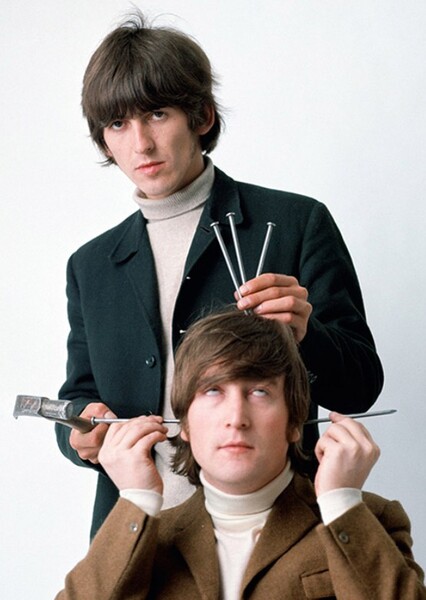
Maxwell Edison is the titular villainous main protagonist of the 1969 Beatles song "Maxwell's Silver Hammer". He is a serial killer who was majoring in medicine as a college student until he murders a love interest, Joan, his teacher, and his judge.
What is strange about the song, is its up-beat tone with the lyrics talking about Maxwell's heinous and murderous crimes against innocent people. This could be a representation of Maxwell's character, as a person who does not realize the actually insanity of his crimes, primarily doing it for fun and pleasure. Although this does not mean that Maxwell is purely innocent as he is still sadistic, psychopathic and vicious.
At some point during Maxwell's early life, he had bought or was gifted a silver hammer, which in order to feed his homicidal urges, would grow a hobby of murdering people for no clear motive. His past murders are unknown, but are heavily implied with Maxwell yet to be found guilty of these past murders, as he then starts to study Medicine at an unnamed university. Maxwell calls up a girl named Joan inquiring for her to come to the movies with him. She says yes and as she's getting ready to leave for the movies, Maxwell knocks on her door and murders her with a silver hammer. He ends up bludgeoning Joan until she was surely dead. Later, Maxwell is in school and he starts to annoy the teacher. The teacher ends up holding Maxwell in detention after school. She made him write repetitively to discipline him. Maxwell waited until the teacher turned around letting him bludgeon her with the silver hammer he used to kill Joan. Maxwell ends up in court for his past crimes and he ends up exaggerating and making embellished points to save himself. Two girls named Rose and Valerie protest in Maxwell's favor to let him go. The judge finds Maxwell guilty causing Maxwell to murder the judge in a blind rage with the silver hammer. It is implied that Maxwell was still given a sentence after his murder of the judge, with him likely getting life in prison.
Paul McCartney says the song is symbolic of the downfalls of life, being "[his] analogy for when something goes wrong out of the blue, as it so often does".
In "Sgt. Pepper's Lonely Hearts Club Band" (1978), the fantasy-comedy featuring Peter Frampton and the Bee Gees based upon some of the Beatles' music, the character of Maxwell Edison is played by legendary comedian Steve Martin, reimagined as a deranged, money-driven anti-aging specialist who turns "ugly old, corrupt people into handsome young corrupt people". Despite Martin's name appearing heavily in advertisements, Maxwell appears more as a minor antagonist.