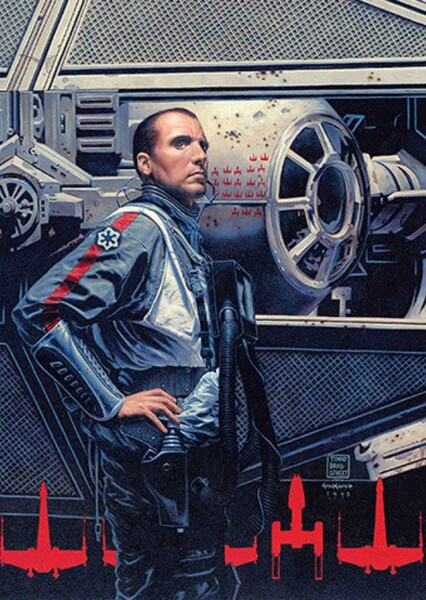
In Real Life, an ace is technically a fighter pilot with five or more kills. This is harder than it sounds; even in conflicts like the World Wars, where aerial combat occurred on a vast scale, the average pilot had zero confirmed kills from the day he got his wings to the day he bought his farm. In WWI, where the concept of a "flying ace" was first invented, it was mainly for morale-boosting propaganda— air combat at the time was in large formations where individual skill mattered less than teamwork and numbers. In WWII, only about 5% of pilots made ace, and they were responsible for 50% of all air-to-air kills. Official ace status was harder to achieve in some air forces than in others, because standards varied from nation to nation on how much evidence was required to "confirm" a kill. The term is most commonly associated with aircraft pilots, but other types, such as tank aces, also exist. Ace pilots are common in fiction, most prominently in mecha shows and any Space Opera featuring space fighter planes. They tend to be more prominent in Real Robot shows, where the mecha themselves are fairly equal and the pilot's skills are more important, than in Super Robot shows, which place more emphasis on the power of the mecha while the pilot's main asset is Heroic Spirit. An ace pilot will likely display all sorts of Improbable Piloting Skills, such as the High-Speed Missile Dodge. They may or may not come with wingmates. They will often have Machine Empathy, allowing them to sense problems from subtle differences in how their craft moves/feels/sounds, especially if flying their Ace Custom. Depending on the time period, may wear an Adventurer Outfit. An Ace who excels even beyond other aces is known as an Ace of Aces, a title typically granted only to a nation's highest scoring ace. An ace pilot is not necessarily The Ace in terms of personality, although they can be. Famous aces may be given a cool-sounding nickname like, oh, say, the Red Baron. They also may only be Graceful in Their Element, and are (though not The Klutz) plodding on land. As well as anyone has been able to determine, aces are born, not trained.note But Improbable Piloting Skills or Improbable Aiming Skills do not guarantee one to become an ace. The most important factor is luck; that is, to actually meet enemies and face them in the air. In WWII, only 50% of American fighter pilots ever met Axis airplanes in the air. On the other hand, in a target-rich environment, such as that which the RAF faced at Malta, any pilot will eventually become an ace if he survives long enough. The second important factor is rank: it must not be too low nor too high. Most kills are scored by flight and squadron leaders, who essentially control when and how their formation engages. Ranks below First Lieutenant usually serve as wingmen, whereas Lieutenant Colonel and higher ranks are usually preoccupied with desk jobs. Many pilots have actually refused promotion in order to be able to fly and score victories. Note that wingmen also may themselves be aces, especially if they fly in a target-rich environment. Sometimes aces prefer to fly together as each others' wingmen. This is known as Fat Cat Flight. Piloting Styles Preferred By Aces Steamrollers are aggressive types who favor in-your-face frontal assaults, raining fire or blows on their enemy to keep them off-balance. Experienced pilots can almost always dodge a frontal attack, but if you keep pressing the attack, sooner or later they might slip up and take a hit. Because this tactic results in exciting, close-ranged fights with a lot of interplay between the two combatants, this is a particularly popular variant for protagonist aces in fiction. Bushwhackers are cunning, devious pilots who eschew easy-to-evade frontal attacks in favor of taking potshots from the rear or other blind spots. When engaged in a duel, they try to wriggle out of it and drop out of the enemy's field of view so they can come in from another direction and catch the foe off-guard. Frequently, bushwhackers will sacrifice spare weapons as decoys, distracting the enemy so they can ambush them from behind (e.g, the Picard Maneuver). Most real world aces are Bushwhackers, as are most Real Robot protagonists due to the nature of the genre. Snipers are similar to bushwhackers, but rather than using skill to escape a duel, have the accuracy and firepower to end each duel the moment it begins. They hide behind asteroids, colonies, or cloud cover, popping up to take potshots at their targets, and try to avoid close combat and running battles at all costs. Alternatively, they just blow up whatever's ahead of them before their targets even know that they're being targeted, like with modern day fighter jets. Pluggers — for want of a better term — are defensive players, who manage to stay calm and collected even under continuing attacks from bushwhackers or steamrollers. By continually dodging and deflecting enemy attacks, they can tie up otherwise dangerous foes in time-wasting sparring matches, and may even be able to sneak in the occasional counterattack. In fiction, this style is typically the province of secondary characters, but there are occasional leads who fit the profile (such as Mobile Suit Victory Gundam hero Uso Evin). Note that fights against other veterans are usually a better indicator of an ace's style than battles against Mooks, who are generally taken out with little effort. Another classification, coming from the Finnish Air Force, is differentiating pilots who fly with their "brains" versus pilots who fly with their "muscles". Those who fly with their brains usually have superb mathematical and 3D skills, being able to manage the situation like a computer and form a clearer view of the chaotic scene of battle. They are excellent shots and do not take unnecessary risks but rather attempt to attack the enemy from his blind spots and break off ASAP. Those who fly with their "muscles" are superb pilots, extremely aggressive, prefer dogfights and maneuvers, and are good with aerobatics but not necessarily crack shots. Either can become aces. "Bushwackers" and "snipers" are "brain" pilots whereas "steamrollers" and "pluggers" are "muscle" pilots. The difference is best illustrated by the von Richthofen brothers: Manfred (the original Red Baron with 80 kills) was a "brain" pilot, whereas his little brother Lothar (with 40 kills) was a "muscles" pilot. Civilian examples exist as well, and not just for aircraft. Although civilian pilots obviously don't meet the military definition because they're not killing people unless they horribly fail, some civilians have saved lives and property with overwhelming skill and capability, overcoming multiple engine failures, hydraulic failures, or many other incidents which would fall under No One Could Survive That!
Ace Pilot has been suggested to play 4 roles. Click below to see other actors suggested for each role, and vote for who you think would play the role best.
Ace Pilot has been suggested to play 4 roles. Click below to see other actors suggested for each role, and vote for who you think would play the role best.