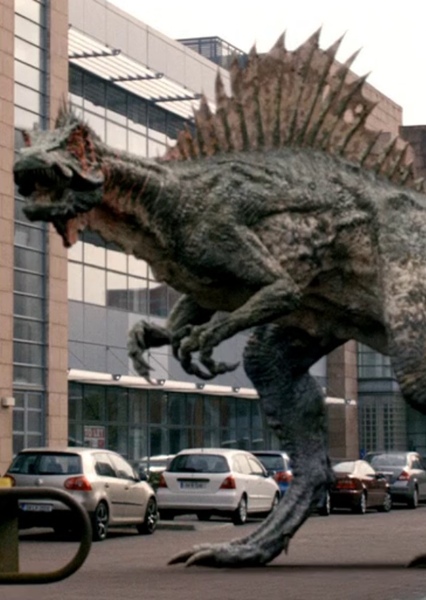
Spinosaurus (meaning "spine lizard") is a genus of spinosaurid dinosaur that lived in what now is North Africa during the Cenomanian to upper Turonian stages of the Late Cretaceous period, about 99 to 93.5 million years ago.[2][3] This genus was known first from Egyptian remains discovered in 1912 and described by German paleontologist Ernst Stromer in 1915. The original remains were destroyed in World War II, but additional material has come to light in the early 21st century. It is unclear whether one or two species are represented in the fossils reported in the scientific literature. The best known species is S. aegyptiacus from Egypt, although a potential second species, S. maroccanus, has been recovered from Morocco. The contemporary spinosaurid genus Sigilmassasaurus has also been synonymized by some authors with S. aegyptiacus, though other researchers propose it to be a distinct taxon. Another possible junior synonym is Oxalaia from the Alcântara Formation in Brazil. Spinosaurus was among the largest of all known carnivorous dinosaurs, nearly as large as or even larger than other theropods such as Tyrannosaurus, Giganotosaurus and Carcharodontosaurus. Estimates published in 2005, 2007, and 2008 suggested that it was between 12.6 to 18 meters (41 to 59 ft) in length and 7 to 20.9 metric tons (7.7 to 23.0 short tons) in weight.[4][5][6] New estimates published in 2014 and 2018, based on a more complete specimen, supported the earlier research, finding that Spinosaurus could reach lengths of 15 to 16 meters (49 to 52 ft).[7][8][9] The latest estimates suggest a weight of 6.4 to 7.5 metric tons (7.1 to 8.3 short tons).[8][9] The skull of Spinosaurus was long, low and narrow, similar to that of a modern crocodilian, and bore straight conical teeth with no serrations. It would have had large, robust forelimbs bearing three-fingered hands, with an enlarged claw on the first digit. The distinctive neural spines of Spinosaurus, which were long extensions of the vertebrae (or backbones), grew to at least 1.65 meters (5.4 ft) long and were likely to have had skin connecting them, forming a sail-like structure, although some authors[who?] have suggested that the spines were covered in fat and formed a hump. Spinosaurus's hip bones were reduced, and the legs were very short in proportion to the body. Its long and narrow tail was deepened by tall, thin neural spines and elongated chevrons, forming a flexible fin or paddle-like structure. Spinosaurus is known to have eaten fish, and most scientists believe that it hunted both terrestrial and aquatic prey. Evidence suggests that it was highly semiaquatic, and lived both on land and in water as modern crocodilians do. Spinosaurus's leg bones had osteosclerosis (high bone density), allowing for better buoyancy control, and the paddle-like tail was likely used for underwater propulsion. Multiple functions have been put forward for the dorsal sail, including thermoregulation and display; either to intimidate rivals or attract mates. Spinosaurus lived in a humid environment of tidal flats and mangrove forests alongside many other dinosaurs, as well as fish, crocodylomorphs, lizards, turtles, pterosaurs, and plesiosaurs.
Spinosaurus

Dinosaurs/Creatures
for Dinosaurs/Creatures in Primeval HBO series Remake
Suggested by _castaway_
Strange, unexplained "anomalies" have ripped multiple holes in the fabric of time and space, allowing dangerous (and dangerously hungry) creatures from the distant past to lumber onto the streets of modern Britain. A crack team of specialists were appointed by the government to investigate and control these "creature incursions," creating the Anomaly Research Center (ARC), which is now jointly owned by the government and by entrepreneurial scientist Philip Burton. The ruthless, manipulative Burton heads ARC's control center, often butting heads with government official James Lester, while zoologist Matt Anderson leads a capable crew in the field. They are under siege, however -- anomalies are becoming more numerous, unpredictable and dangerous than ever before, and the end of the world seems to be just around the corner.