Age: 64
male
John Hannah (born April 23, 1962) is a Scottish actor of film and television. He has appeared in Stephen Sommers' Mummy Series, Richard Curtis' Four Weddings and a Funeral, and Sliding Doors with Gwyneth Paltrow. After completing his secondary education, Hannah enrolled at the Royal Scottish Academy of Music and Drama (now known as the Royal Conservatoire of Scotland) in Glasgow. His time at the academy laid the foundation for his acting career, and he graduated with honors. John Hannah's acting career took off in the late 1980s and early 1990s with notable stage performances, including roles with the Royal Shakespeare Company. His breakthrough on the big screen came with the critically acclaimed film "Four Weddings and a Funeral" (1994), where he played the endearing and scene-stealing character, Matthew. The film's success catapulted Hannah into international recognition. Following his success in "Four Weddings and a Funeral," he continued to build a diverse and impressive filmography. He starred in films such as "Sliding Doors" (1998), "The Mummy" (1999), and its sequel "The Mummy Returns" (2001), gaining popularity for his charismatic and versatile performances. Additionally, he showcased his talent in television, earning praise for his roles in series like "Rebus" and "Spartacus." Beyond the screen, he maintains a private personal life. In 1996, he married actress Joanna Roth, and the couple has two children. Despite his fame, he remains known for his down-to-earth demeanor and commitment to his craft.
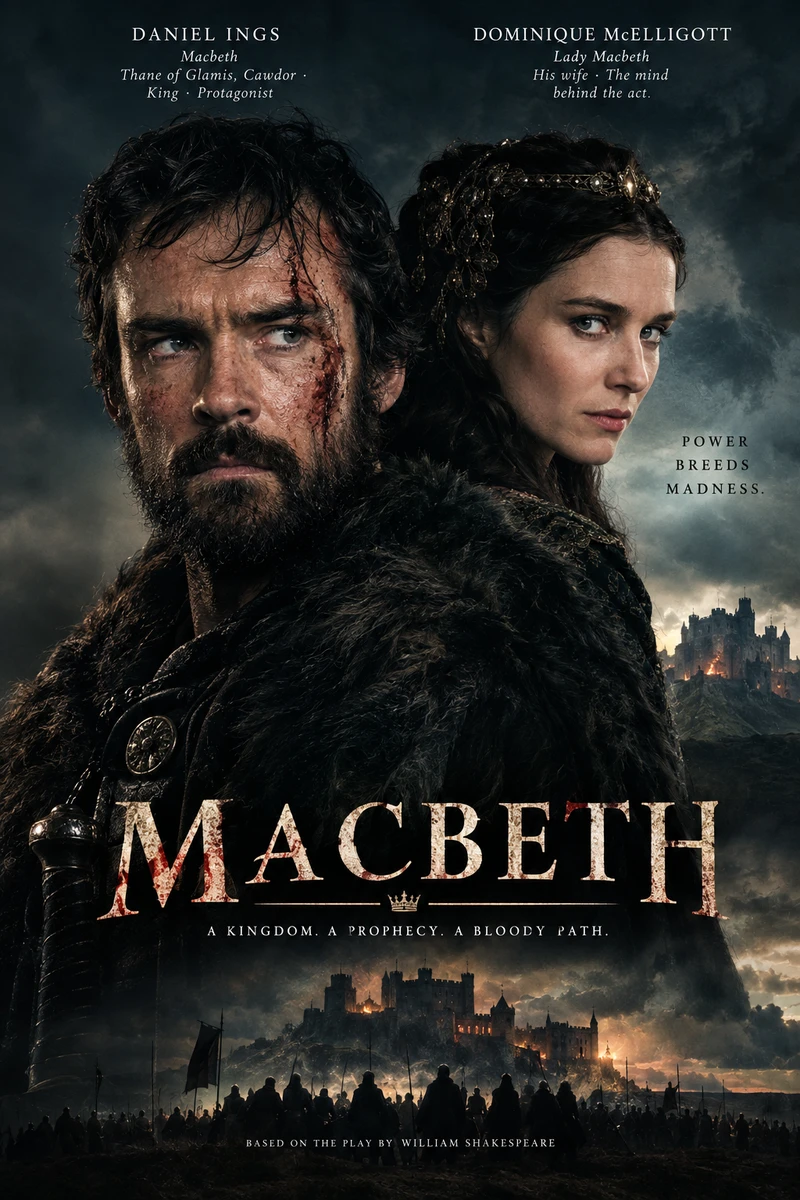
He was the greatest warrior in Scotland. She was the sharpest mind in his castle. Together they committed the one act that cost them everything — including each other. A period production of Shakespeare's most compressed and most terrifying tragedy — set in the specific historical world of medieval Scotland with full atmospheric commitment to the play's darkness. The film treats the Macbeth-Lady Macbeth relationship as the specific partnership it is: two extraordinarily capable people who make a decision together and are destroyed by it separately, at different rates, in different ways. Lady Macbeth's psychological dissolution is given equal screen time to Macbeth's political paranoia. The Weird Sisters are treated neither as theatrical convenience nor supernatural certainty — they are ambiguous, possibly internal, possibly external, and the film refuses to decide. The visual language: grey, wet, dark — Scotland in the specific light of a kingdom eating itself. Act One — The Prophecy The battlefield. The witches. Macbeth's first private response to the prophecy — the film's most important single shot. Duncan's arrival at Inverness. Act Two — The Act Duncan's murder. Lady Macbeth's management of the aftermath. Macbeth's hands. The knocking at the gate. Act Three — The Dissolution The banquet. Banquo's ghost. Lady Macbeth's sleepwalking. Macbeth's increasingly isolated paranoia. Act Four — The End Birnam Wood moving. Lady Macbeth's death. Macbeth's last battle and his specific dignity in facing it.