Age: 49
male
Benedict Timothy Carlton Cumberbatch (born July 19, 1976) is an British and American actor. Known for his roles on the screen and stage, he has received various accolades throughout his career, including a Primetime Emmy Award, a British Academy Television Award, and a Laurence Olivier Award. Cumberbatch won the Laurence Olivier Award for Best Actor in a Leading Role in a Play for Frankenstein and a Primetime Emmy Award for Outstanding Lead Actor in a Miniseries or Movie for Sherlock. His performances in the dramas The Imitation Game (2014) and The Power of the Dog (2021) earned him nominations for an Academy Award, a BAFTA Award, a Screen Actors Guild Award, and a Golden Globe Award, all for Best Actor in a Leading Role. For playing the title role in five-part drama miniseries Patrick Melrose, he won a BAFTA TV Award for Best Actor in a Leading Role. In 2014 Time magazine included him in its annual list of the 100 most influential people in the world, and in 2015 he was appointed a CBE by Queen Elizabeth II in the 2015 Birthday Honours for services to the performing arts and to charity. A graduate of the Victoria University of Manchester, Cumberbatch continued his training at the London Academy of Music and Dramatic Art, obtaining a Master of Arts in Classical Acting. He first performed at the Open Air Theatre, Regent's Park in Shakespearean productions and made his West End debut in Richard Eyre's revival of Hedda Gabler in 2005. Since then, he has starred in the Royal National Theatre productions After the Dance (2010) and Frankenstein (2011). In 2015, he played the title role in Hamlet at the Barbican Theatre. Cumberbatch's television work includes his performance as Stephen Hawking in the television film Hawking in 2004. He gained worldwide recognition for his performance as Sherlock Holmes in the BBC series Sherlock from 2010 to 2017. He has also headlined Tom Stoppard's adaptation of Parade's End (2012), The Hollow Crown: The Wars of the Roses (2016), Patrick Melrose (2018), and Brexit: The Uncivil War (2019). In films, Cumberbatch has starred in Amazing Grace (2006) as William Pitt the Younger, Star Trek Into Darkness (2013) as Khan, 12 Years a Slave (2013) as William Prince Ford, The Fifth Estate (2013) as Julian Assange, and The Imitation Game (2014) as Alan Turing. He also acted in the historical dramas The Current War (2017), 1917 (2019) and The Courier (2020), and received critical acclaim for his performance in Jane Campion's Western drama The Power of the Dog (2021). From 2012 to 2014, through voice and motion capture, he played the characters of Smaug and Sauron in The Hobbit film series. Cumberbatch portrays Dr. Stephen Strange in the Marvel Cinematic Universe films, beginning with Doctor Strange (2016), and also voiced the character in the animated series What If...? (2021).
Benedict Cumberbatch

British captain
for British captain in Canada: A Mysterious Story
Suggested by danicaharper
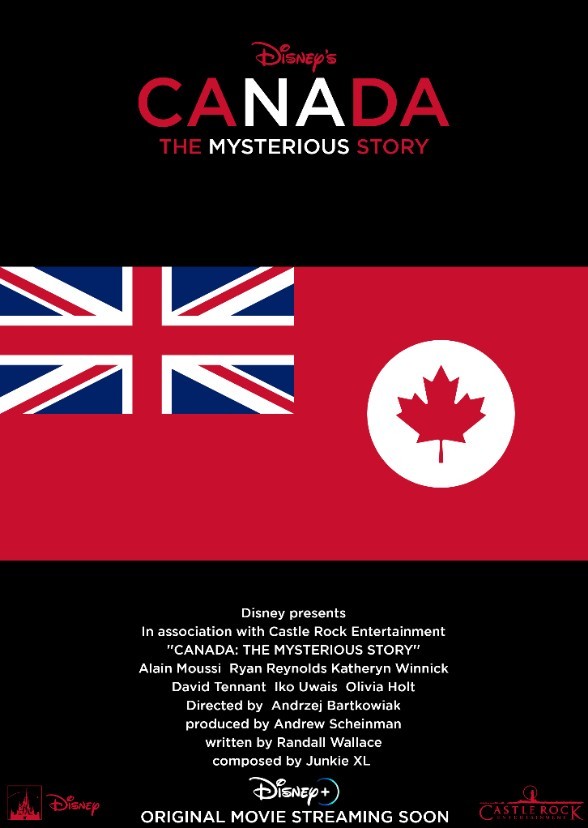
Prior to European colonization, the lands encompassing present-day Canada were inhabited for millennia by Indigenous peoples, with distinct trade networks, spiritual beliefs, and styles of social organization. Some of these older civilizations had long faded by the time of the first European arrivals and have been discovered through archeological investigations. From the late 15th century, French and British expeditions explored, colonized, and fought over various places within North America in what constitutes present-day Canada. The colony of New France was claimed in 1534 with permanent settlements beginning in 1608. France ceded nearly all its North American possessions to the United Kingdom in 1763 at the Treaty of Paris after the Seven Years' War. The now British Province of Quebec was divided into Upper and Lower Canada in 1791. The two provinces were united as the Province of Canada by the Act of Union 1840, which came into force in 1841. In 1867, the Province of Canada was joined with two other British colonies of New Brunswick and Nova Scotia through Confederation, forming a self-governing entity. "Canada" was adopted as the legal name of the new country and the word "Dominion" was conferred as the country's title. Over the next eighty-two years, Canada expanded by incorporating other parts of British North America, finishing with Newfoundland and Labrador in 1949.